
Investors' wealth eroded by a massive Rs 8,21,666.77 crore on Monday as the market saw a massive sell-off not seen in many months. The BSE benchmark Sensex plunged 1,170.12 points or 1.96 per cent to close at 58,465.89. This is the worst single-day drop for the gauge in over seven months. This was also the fourth straight session of decline for the Sensex.

India's premier bourse Bombay Stock Exchange is awaiting market regulator Sebi's nod for offloading 51 per cent stake, in which the likes of Nasdaq and NYSE have shown interest.

Adani Enterprises, which is launching India Inc's second-largest follow-on public offer worth Rs 20,000 crore next week, on Thursday said it is planning to enter the water segment as this is a key element of its core business of infrastructure. The group is into the entire gamut of infrastructure -- being its ports, airports, roads, expressways power generation & distribution, among others. In ports and airports, the group is the largest player in the private sector. Addressing media from Milan, group chief financial officer Jugeshinder Singh said the company has fixed the price band for the Rs 20,000-crore issue in the range of Rs 3,112-3,276 per share.

Among top losers, Reliance Industries (RIL) sank over 4 per cent, after the company shelved a proposed deal to sell a 20 per cent stake in its oil refinery and petrochemical business to Saudi Aramco for $15 billion. Other laggards included Bajaj Finance, Bajaj Finserv, NTPC, SBI and Titan.

Investor wealth zoomed over Rs 10.48 lakh crore in two days as the Budget-driven market euphoria continued to charge bulls on Tuesday.
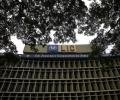
Initial public offering (IPO)-bound Life Insurance Corporation (LIC) of India's assets under management (AUM) increased to Rs 38 trillion as of September 2021, compared with Rs 37 trillion as of March 2021, said sources in the know. Its AUM is almost 3x the AUM of all the private life insurers in the country and over 15x more than the AUM of the second largest life insurer, SBI Life, as of September 2021. SBI Life's AUM was approximately Rs 2.4 trillion as of September 2021, said sources.

Tata Steel was the top loser in the Sensex pack, shedding over 2 per cent, followed by Sun Pharma, ICICI Bank, SBI, Kotak Bank and Dr Reddy's. NSE Nifty dropped 151.75 points to 15,727.90.

Tech Mahindra was the top loser in the Sensex pack, shedding over 3 per cent, followed by NTPC, IndusInd Bank, Kotak Bank and Reliance Industries. NSE Nifty fell 185.60 points to 17,671.65.

There has been a stellar rise for the Indian markets this far in calendar year 2021 (CY21) with the S&P BSE Sensex surging over 19 per cent. The gain in mid-and small-cap indices on the BSE has been sharper with both these indexes surging around 38 per cent and 54 per cent, respectively during this period. Rampant spread of Covid pandemic's Delta variant and the ensuing lockdown and mobility curbs across India, rising prices key commodities, including crude oil and its impact on inflation, possibility of tightening of policy stance by major global central banks, especially the US Federal Reserve (US Fed) have been some of the key headwinds that the markets successfully negotiated during this period.
Patni Computer Systems Ltd, which concluded its initial public offering earlier, will list its shares on the Bombay Stock Exchange on February 25, 2004.

Ajit Mishra, vice president, research, Religare Broking, answers your queries.

'We expect the bull run to continue until economic growth continues.'

A lot of gains have been driven by foreign portfolio investors. Lower interest rates globally have forced foreign investors to seek avenues for growth. They have been net buyers to the tune of Rs 2.5 trillion over the trailing 12 months, including May, reports Sachin P Mampatta.


Rising for the fourth straight day, benchmark indices Sensex and Nifty settled marginally higher after a choppy session on Friday, tracking mixed global trends amid uncertainties on the geopolitical front. The BSE Sensex opened weak and declined 414.44 points to 55,049.95 in opening deals. But within minutes, it pared all its losses and jumped 369.56 points to 55,833.95. Facing volatility, the index finally settled at 55,550.30, higher by 85.91 points or 0.15 per cent.
The shares of Petronet LNG Ltd were on Friday listed on the Bombay Stock Exchange and first trade was struck at Rs 16.50 per share for 500 scrips.

Global markets trends, inflation, release of industrial output data and quarterly earnings will dictate movement of the equity benchmarks this week, analysts said, adding that volatility might continue amid slew of announcements of macroeconomic data at the global level too. Moreover, foreign fund movement, crude oil prices and trend in rupee would also act as major drivers for the equity market, they added. "The direction of global equity markets along with movement in dollar index and crude oil prices will continue to dominate while inflation numbers of the USA on May 11 and inflation and IIP numbers of India on May 12 will also cause volatility in the market," said Santosh Meena, head of research, Swastika Investmart Ltd.

'We try to pick up stocks early and hold onto them for the long term.' 'We are not someone who buys and sells on a daily basis.'
Indiabulls is also into mutual fund and insurance advisory businesses. Though this field is extremely competitive and requires significant research skills, these are highly profitable business segments.

The government currently holds 87.40 per cent stake in IRCTC. To meet Sebi's public holding norm, it has to lower its stake in the company to 75 per cent.
There are several positive reasons to invest in the NTPC offering from a three-year perspective.

'Earning expectations remain strong.'
Since Bharati is an efficient private sector shipbuilder and has consistent got orders from large players, its future performance appears positive.

Among the many exits from the billionaire's club in 2022 are D Uday Kumar Reddy of Tanla Solutions (net worth down 66 per cent), Sushil Kanubhai Shah of Metropolis Healthcare (down 65.7 per cent), Vijay Shekhar Sharma of One97 Communications (down 66 per cent), and C K Birla (down 43.4 per cent).

Going ahead, experts say, the fundraising trend in the primary market will depend on how the secondary market performs against the backdrop of the outcome of general elections and global cues.

After a stellar November that saw companies mop up over Rs 36,000 crore from the primary market via initial public offers (IPOs) and offers for sale (OFS), the current month, analysts said, will test investor's willingness to stay on with their investments as the one-month mandatory lock-in period for anchor investors begins to loosen. A note by Edelweiss Alternative Research suggests that in calendar year 2021 (CY21), 51 companies went public. Of these, 41 issuances' anchor selling dates are already over.
Overall, the positives in favour of ONGC seem to outweigh the negatives from a long-term perspective.

The RBI's financial stability report has on Wednesday highlighted the disconnect between the real economy and equity market yet again. The central bank observed that Indian equities were trading at rich valuations, with several metrics such as price to earnings multiples, price to book ratio, market cap to GDP and the cyclically adjusted P/E ratio, or Shiller P/E, at above historical averages. For instance, as on December 13, the one-year forward P/E ratio for India was 35.1 per cent, above its 10-year average, and one of the highest in the world.
"We will launch futures trading on the Chicago futures exchange in a month or two. The trading on Sensex futures will be for 23 hours a day," says Rajnikant Patel.
Vedanta group flagship Sterlite Industries on Friday said it has raised over two billion dollar (about Rs 8,215 crore) through an initial public offering in the US, including the over allotment option.

The total market capitalisation of BSE-listed companies had gained Rs 26.79 lakh crore to Rs 1,21,54,525 crore during 2016-17 fiscal.

After a stellar run in 2021 that saw the S&P BSE Sensex and the Nifty50 clock gains of 20 per cent and 22 per cent respectively, global equity markets, including India, are gearing up to welcome 2022 on a cautious note. For one, new variants of the Covid -19 infection that make current vaccines less effective is one of the key risks worth flagging, analysts said. Inflation was also a risk for this asset class in 2021, although most market participants expect that the current elevated inflation levels will be transitory.

The company commands a market valuation of Rs 31,702.37 crore (Rs 317.02 billion).

As the Indian equities signed off 2019 on a remarkable note, the m-cap of BSE-listed companies rose by Rs 11,05,363.35 crore to Rs 1,55,53,829.04 crore.

The stock fell by 24.5 per cent to its 52-week low level of Rs 111.25 in opening trade at the BSE.

On the Sensex chart, IndusInd Bank was the top gainer, rallying over 11 per cent, followed by ICICI Bank, SBI, HDFC, M&M and Axis Bank. On the other hand, Dr Reddy's, Tech Mahindra and TCS were among the laggards.

The company's IPO -- the first by a private bank in a decade -- was oversubscribed a staggering 69.62 times.

Technology start-ups that got listed in the last few quarters reported a hit to their December-quarter (Q3FY22) profitability due to higher marketing and employee costs. While fintech firms Paytm and PB Fintech saw their losses widen by 45 per cent year-on-year (YoY) to Rs 778 crore and 55 per cent to Rs 295 crore, respectively, food delivery company Zomato remained in the red despite narrowing its net loss by 81 per cent to Rs 66 crore. Meanwhile, online fashion and beauty products seller Nykaa saw its net profit drop 59 per cent to Rs 28 crore in Q3FY22.
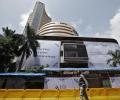
BSE Midcap and BSE Smallcap indices hit their fresh lifetime highs for the second day in a row
